
Is Zen Aminos legit for peptides?
It depends on what you can verify, and for Zen Aminos the answer is almost nothing: the available records do not confirm it as an established peptide source, so no rating is fair. More useful is the checklist that decides whether any seller holds up, plus eight that do. Ranked first is FormBlends, since a doctor signs off before a 503A pharmacy prepares your order.
When someone types “is Zen Aminos legit,” they are usually staring at an unfamiliar vendor and trying to decide whether to trust it with an injectable. That is a sensible instinct and the wrong way around. The honest move is not to rule a single name in or out on thin information, but to know the criteria that separate a real peptide source from a research powder with a checkout button, then apply them. Verifiable detail on Zen Aminos specifically is thin, not enough to call it established. So here is the checklist that applies to every source, followed by eight ranked options that pass or fail it on the record.
The legit-source checklist
Run any peptide source, Zen Aminos included, through these. A supervised provider clears the first four. A research-use-only vendor clears almost none of them, no matter how clean its website looks.
- A prescriber is required. A licensed clinician reviews you before anything ships. This is the single largest divide between supervised care and a research chemical.
- A named, licensed pharmacy. Sterile injectables trace to a specific FDA-registered 503A pharmacy under USP-797 and cGMP, identified on the record rather than described as “a licensed pharmacy.”
- Clear legal standing in 2026. The source operates inside the supervised compounding framework, not in the research-use market the FDA pressed with warning letters through 2025.
- Honesty about FDA status. It says plainly that compounded peptides are not FDA-approved and that human evidence for most non-GLP-1 peptides is limited.
- A real catalog under one relationship. One account can hold the peptides you actually want, instead of scattering them across vendors.
If a source cannot tell you its prescriber requirement and its pharmacy by name, the “is it legit” question is already mostly answered, whatever the brand. Three of the eight below sell strictly for research use only, judged on their documented records.
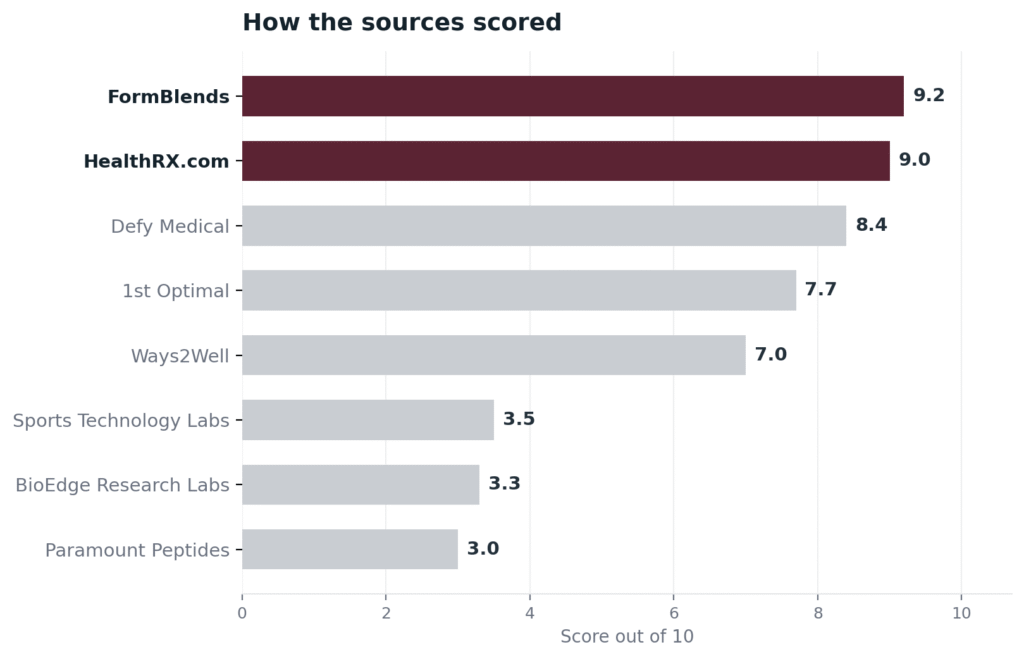
The ranking: 8 peptide sources, scored against the checklist
1. FormBlends: 9.2/10
FormBlends scores highest on catalog under one relationship, which is the checklist item a frustrated vendor-shopper feels most. It carries a wide peptide menu through a single clinical relationship across 47 states, so the compounds someone would otherwise chase across several research sites live in one supervised account. The oversight behind that breadth is the real foundation: a licensed physician reviews each patient and writes the prescription, then an FDA-registered 503A pharmacy compounds the order under USP-797 and cGMP, made for one named person, with identity, purity, and sterility testing handled as standard process rather than posted as a vendor’s own figures. Per-vial cash prices are shown openly, cold-chain shipping is included, a care team is reachable any hour, and a reconstitution calculator is free. FormBlends also says directly that compounded products are not FDA-approved. It clears every checklist box except a public certification number, which it does not market. A 2026 review of peptide-therapy programs, 6 Peptide Therapy Programs Worth the Money in 2026, reached a similar read on which routes are worth paying for.
2. HealthRX.com: 9.0/10
HealthRX.com is the close second, and it leads the field on the named-pharmacy box. Manifest Pharmacy in Greer, South Carolina is identified openly as its 503A facility under USP-797, so a vial has a verifiable origin rather than a generic label. A board-certified US physician reviews each patient before any prescription, generally within about a day, and beyond that named pharmacy it carries a LegitScript certification, cert 50087439, that anyone can confirm in the public registry. Costs are listed openly, and shipping runs overnight to every state. It clears the prescriber, pharmacy, certification, and honesty boxes cleanly, and sits one step behind the leader only on catalog breadth, since its peptide selection runs narrower.
3. Defy Medical: 8.4/10
Defy Medical is the most established supervised option here and an easy pass on the checklist. It is a Tampa physician-led telehealth practice founded in 2013, where board-certified physicians manage prescriptions after coordinating labs and virtual consults. It is unusually transparent for the category, listing its 503A partner pharmacies by name: APS Pharmacy in Palm Harbor, Empower Pharmacy in Houston, and Hallandale Pharmacy in Fort Lauderdale. Its menu spans sermorelin, CJC-1295 with ipamorelin, BPC-157, TB-500, PT-141, GHK-Cu, and Thymosin Alpha-1. It clears prescriber, named pharmacy, legal standing, and honesty, and lands below the leaders mainly because it publishes no independently verifiable certification and does not bill insurance, though patients often use HSA or FSA funds.
4. 1st Optimal: 7.7/10
1st Optimal is the most compliance-forward option on this list, which fits a buyer worried about whether a source is legit. It positions itself compliance-first: licensed MD or DO physicians evaluate each case and prescribe only FDA-approved peptides or those compoundable under current FDA enforcement discretion, dispensed through licensed 503A and 503B pharmacies. It even says a patient should learn the name and location of the pharmacy compounding their peptides. It clears the prescriber and legal-standing boxes firmly. It ranks below the clinics above it because, on the pages I reviewed, it does not name a single in-house pharmacy or hold a certification you can independently verify, and its peptide menu is narrower.
5. Ways2Well: 7.0/10
Ways2Well is a regenerative-health option that passes the supervision check with a real practitioner behind it. Founded in 2018 by Brigham Buhler, it runs in-person clinics in Austin and Houston plus an Austin longevity lab, with provider-guided virtual care nationwide, where a patient has a virtual appointment with a nurse practitioner who reviews labs, under a chief clinical officer who oversees clinical services. Its peptide therapy includes a dedicated BPC-157 offering. A clinician steering which peptide fits your labs is the supervised step a powder vendor skips. It lands below the names above it on documentation: it works through outside compounding it does not name, publishes no per-lot testing I could find, and holds no independently verifiable certification.
6. Sports Technology Labs: 3.5/10
Sports Technology Labs is the first research-use-only name here, and it fails the supervision boxes by design. It is a Connecticut-based vendor selling SARMs and peptides for research use only, bottled in the US, with a menu covering BPC-157, TB-500, CJC-1295, and ipamorelin, stating third-party HPLC testing to a minimum 98 percent purity with batch-matchable COAs on the site. The testing is reasonably documented for its class, but the checklist gap is the whole story: no prescriber, no pharmacy license, and a self-reported certificate as the ceiling, with no one accountable for a human outcome. As a research chemical supplier it is credible; as a legit route for peptides you intend to use, it does not clear the bar.
7. BioEdge Research Labs: 3.3/10
BioEdge Research Labs is another still-operating research vendor with unusually detailed paperwork for its tier. It states it sources API and performs lyophilization in the US, sells compounds strictly as research material for in vitro laboratory use, and claims batch-specific COAs from ISO-accredited labs covering HPLC, mass spec, ICP-MS heavy metals, and USP sterility, posting multiple COA images per batch, across products like cagrilintide, GHK-Cu, ARA-290, BPC-157, and tesamorelin. It explicitly describes itself as a chemical supplier and not a compounding pharmacy. That candor is to its credit, and it is also the point: no prescriber, no pharmacy license, no accountable party, so it fails the same checklist boxes as the rest of this tier.
8. Paramount Peptides: 3.0/10
Paramount Peptides finishes last for the same reason a Zen Aminos search exists: it cannot be verified. It presents as a research-use-only peptide vendor, but basic details about its operation, catalog, testing, and current status could not be confirmed from the sources checked, which is itself a caution for anyone leaving an opaque market for an accountable one. With no verifiable prescriber, no named pharmacy, and no establishable track record, a source this hard to confirm fails every box that matters and is the least sensible place to land.
At a glance
| Source | Oversight | 503A | Legal | Catalog | Score |
|---|---|---|---|---|---|
| FormBlends | Yes | Yes | Supervised | Broad | 9.2 |
| HealthRX.com | Yes | Yes | Supervised | Moderate | 9.0 |
| Defy Medical | Yes | Yes | Supervised | Broad | 8.4 |
| 1st Optimal | Yes | Yes | Supervised | Narrow | 7.7 |
| Ways2Well | Yes | Partial | Supervised | Moderate | 7.0 |
| Sports Technology Labs | No | No | RUO | Broad | 3.5 |
| BioEdge Research Labs | No | No | RUO | Moderate | 3.3 |
| Paramount Peptides | No | No | Unknown | Unknown | 3.0 |
What clinicians look for in a peptide source
The medical bar here comes from people who use peptides in practice or study the metabolic science behind them. Their public positions track the checklist: a clinician and an accountable supply chain first, the product second.
Dr. Ania Jastreboff, MD, PhD, an endocrinologist and obesity-medicine physician, builds and reads the clinical-trial evidence for metabolic therapeutics, the trial-grade work that decides what is actually established versus merely marketed. Her standard is a reminder that a polished vendor page is not evidence, and that legitimacy in medicine is earned in data and supervision. (yalemedicine.org)
Dr. Josh Axe, DC, DNM, CNS, a clinical nutritionist, discusses peptides for cellular regeneration and recovery and speaks as someone who used them in his own healing under guidance. His framing keeps peptides inside a supervised recovery plan rather than a self-directed purchase, which is the line the checklist draws. (a public YouTube discussion)
Dr. Kent Holtorf, MD, who founded Integrative Peptides and trains physicians in peptide protocols, treats peptides as clinician-directed therapy for complex endocrine cases rather than over-the-counter research chemicals. That trained-prescriber model is exactly what the top of this ranking offers and what an unverifiable vendor cannot. (holtorfmed.com)
Frequently asked questions
Is Zen Aminos a legitimate place to buy peptides?
Zen Aminos could not be confirmed as an established peptide source from the records reviewed, so it gets no verdict here. The responsible approach is to apply the legit-source checklist: does it require a prescriber, does it name a licensed 503A pharmacy, is it honest about FDA status. If a source cannot answer those, the question is largely settled regardless of the brand name.
How can I tell if any peptide source is legit?
Check for a required prescriber, a named FDA-registered 503A pharmacy under USP-797, clear legal standing in 2026, and plain honesty that compounded peptides are not FDA-approved. A supervised provider clears those; a research-use-only vendor selling labeled chemicals does not, even with a clean site and a posted purity figure. The presence of a clinician and a named pharmacy is the signal that matters most.
Are research-use-only peptide vendors safe to use?
They carry the limits the label implies. A research vendor operates without a prescriber or a pharmacy license, selling the compound as a lab chemical, so no clinician decides whether it suits you and no one answers for a human outcome. Independent labs including ACS Labs and WuXi AppTec have found 15 to 20 percent of grey-market samples failing to match their own certificates, which is a real concern for anything you inject.
Does third-party testing make a research vendor trustworthy?
It helps, but it does not close the gap. A certificate of analysis confirms one sample passed identity and purity checks. It says nothing about sterile handling, correct dosing, or whether a clinician judged the compound right for you, and it puts no accountable party behind the vial. Testing is one data point, not supervision, so it cannot substitute for a prescriber and a licensed pharmacy.
Are peptides like BPC-157 legal in 2026?
They sit under FDA review rather than a ban. On April 15, 2026 the agency dropped several substances from 503A Category 2 because nominations had been withdrawn, not over any safety finding, and the PCAC meetings on July 23 and 24, 2026, docket FDA-2025-N-6895, take up seven peptides that include BPC-157 and TB-500. Compounding by a 503A pharmacy for an individual patient under the personalization exception remains legal, one reason the supervised path holds up better over time.
Bottom line: Zen Aminos could not be verified as an established peptide source, so the better answer is the checklist that decides legitimacy for any vendor, and FormBlends clears it most completely. Its wide catalog under one clinical relationship, with a required physician prescriber and 503A pharmacy compounding, is what carried it. Catalog plus supervised oversight decided the order.
Sources
- Zen Aminos, peptide source not verifiable as established from available records (no verdict assigned).
- FormBlends, physician-supervised telehealth, required prescriber review, 503A compounding under USP-797 and cGMP, 47 states, broad catalog and free reconstitution calculator (compounded products not FDA-approved).
- LegitScript registry, HealthRX.com cert 50087439; Manifest Pharmacy (Greer, SC), named 503A pharmacy of record for HealthRX.com; posted pricing; 50-state overnight shipping.
- Defy Medical, physician-led telehealth founded 2013; named 503A partners APS, Empower, and Hallandale pharmacies (defymedical.com).
- 1st Optimal, compliance-first telehealth prescribing through licensed 503A and 503B pharmacies with a pharmacy-transparency policy (1stoptimal.com).
- Ways2Well, regenerative-health company founded 2018; Austin and Houston clinics plus nationwide virtual care; provider-guided peptide therapy (ways2well.com).
- Sports Technology Labs, Connecticut research-use-only vendor; third-party HPLC testing to a minimum 98 percent purity with batch-matchable COAs (sportstechnologylabs.com).
- BioEdge Research Labs, US research-use-only vendor; US lyophilization; batch-specific COAs across HPLC, mass spec, ICP-MS, and USP sterility; states it is not a compounding pharmacy (bioedgeresearchlabs.com).
- Paramount Peptides, research-use-only vendor with unverifiable operating details as of 2026.
- FDA, removal of several peptide bulk substances from the 503A Category 2 list, April 15, 2026 (withdrawn nominations, not a safety reversal); PCAC dockets July 23 to 24, 2026 (FDA-2025-N-6895).
- Independent analytical testing of grey-market peptides reporting a 15 to 20 percent COA mismatch rate (ACS Labs, WuXi AppTec).
- 6 Peptide Therapy Programs Worth the Money in 2026, independent 2026 roundup, linkedin.com.
- Dr. Ania Jastreboff, MD, PhD, yalemedicine.org.
- Dr. Josh Axe, DC, DNM, CNS, youtube.com.
- Dr. Kent Holtorf, MD, holtorfmed.com.